How to Pick an MVP Development Company
Pick an MVP development company on four things you can verify: a live app they built that you can download today, the names of the people who will write your code, a new build on your own phone every week, and a contract that puts the code and every account in your name. The right company for a first product is a small senior team that has shipped first versions for founders before and will cut your feature list before it prices it. If you have a technical cofounder, or an idea you can test with a landing page, you do not need one yet.
Most founders choose on the pitch deck and the quote. Both are the easiest things for a company to get right and tell you the least about the next three months. The checks in this article take about a week and cost nothing except a few phone calls.
I run a company that builds MVPs, so I have a side in this. I have tried to write the article I would want a friend to read before signing with anyone, including us. If you are still deciding what belongs in a first version at all, read the MVP development guide first and come back.
What an MVP Development Company Does
An MVP company takes an idea and a budget and returns a product in the store with real users on it. That means it does the product thinking as well as the code. It decides with you what the first version leaves out, designs the screens, builds the app and the backend, gets through App Review, and stays for the first weeks after launch when the real bugs show up.
A general agency and a freelancer can both write the same code. The difference is in what else comes with it. Here is how the three compare on the things that matter for a first product.
MVP development company
- Who you get: a small fixed team, usually a designer, one or two engineers and someone who owns the plan.
- Starts with: a paid scoping sprint that ends in a screen list, a timeline and a number.
- Good at: saying no to features, shipping in about three months, handing over cleanly.
- Weak at: very large platforms, long enterprise procurement, work that needs forty people.
General software agency
- Who you get: whoever is free when you sign. Senior people sell the project and the bench builds it.
- Starts with: a requirements document, often a long one, that you are expected to write or approve.
- Good at: building exactly what the document says, at scale, with process around it.
- Weak at: pushing back. More features is more revenue, so the scope tends to grow.
Freelancer
- Who you get: one person, which is the appeal and the risk.
- Starts with: your designs and your backlog. You are the product manager.
- Good at: a small, well-defined app, or adding hands to a team that already has a technical lead.
- Weak at: covering design, mobile, backend and launch alone, and being reachable when they take another contract.
The longer version of this comparison, with the cost of each over a year, is in in-house vs agency vs freelance.

When Hiring an MVP Company Is the Wrong Call
There are five situations where I would tell you to keep your money.
You have a technical cofounder. If someone on the founding team can build the product, they should. They will make a hundred small decisions a week that shape the company, and those decisions should stay inside it. Hire a designer, or a contractor who reports to your cofounder. You do not need a whole team from outside.
You can test the idea without software. A landing page on Carrd or Framer with a Stripe payment link will tell you whether anyone pays. A waitlist tells you whether anyone cares. A lot of marketplaces can run for their first fifty customers on a form, a spreadsheet and you doing the matching by hand. If you have not tried that, try it before you spend five figures.
A no-code tool covers the first version. Internal tools, directories, simple booking flows and member portals can ship on Bubble, Glide or Softr in a couple of weeks for the price of a subscription. You will outgrow it if the idea works. That is a good problem, and you will rebuild with real usage data in hand.
The budget is too thin. Under about $20,000, a good MVP company will turn the project down, and one that accepts will staff it with juniors or cut corners you cannot see. With that budget, pay for a design sprint and a clickable prototype, then use it to raise money or win your first customers.
You cannot give it time. A build needs a decision-maker for a few hours every week. If you are planning to hand over a brief and come back in three months, the team will build its best guess, and you will pay for the guess and then for the correction.
If none of those describe you, an MVP company is probably the fastest route to a real product. You are a non-technical founder with a clear first customer, some evidence that people want the thing and a budget that covers design, build and launch.
How to Build a Shortlist
Start from products, and work back to the companies that made them. Find three or four apps at about your stage that you like using, then ask their founders who built the first version and whether they would hire that team again. Founders answer this question honestly, and often at length.
Directories like Clutch are fine for collecting names. The reviews there are more useful for ruling companies out than for choosing one. Your investors, your accelerator and other founders in your city will give you better names in an afternoon.
Then cut the list down to three with a few filters you can apply from a browser:
- They have shipped first versions. Look for case studies about products that went from nothing to launch. A portfolio of redesigns for large companies is a different skill.
- The apps are live. Every case study should link to the App Store, Google Play or a working URL. Open each one.
- The work looks like yours. The industry matters less than the shape of the product: a consumer app, a marketplace with two sides, a tool with payments.
- They are the right size. A company of two hundred people will not put its best team on a first product. A team small enough that the founder still reads the code review usually will.
- They answer like people. Send a two-paragraph email describing the idea. A reply with three sharp questions is a good sign. A calendar link and a brochure is a sales funnel.
Talk to three companies. Fewer and you have nothing to compare. More than five and you are spending weeks you could be building.
What to Ask and What to Check
Every company will tell you it is senior, fast and communicative. Skip those questions and ask the ones below, which have answers you can check.
Who writes the code
Ask for the names of the people who will work on your product and meet them before you sign. Ask whether they are employees, and whether any part of the work is passed to another firm. Put the named team in the contract. The usual story from founders who were burned is that they bought the people in the sales call and got someone else.
Weekly demos
You should get a build you can install every week, on TestFlight for iPhone or internal testing on Google Play, from the second or third week on. Ask to see what a weekly update looked like on a past project. A status report is not a demo. If you cannot tap it, assume it does not exist yet.
Code ownership
The repository sits in your GitHub organization from the first commit. The Apple Developer and Google Play accounts are in your company's name. The contract assigns all work to you as you pay for it, with no license back to the company and no proprietary framework that only they can maintain.
Fixed scope or time and materials
Fixed price works when the scope is written down to the screen. You know the number, and the company carries the risk of running over. Time and materials works when you are still finding out what the product is, as long as there is a weekly cap and a demo to show for it. My preference for a first product is a short paid scoping sprint, then a fixed price for the version it describes, with a written process for changes. Ask each company which model they use and what happened the last time a project went past its estimate.
References you can call
Ask for two founders, and ask for one whose project had problems. Call them. Ask what went wrong, how they found out and what the company did next. Ask whether the final bill matched the quote. A written testimonial is marketing. Ten minutes on the phone is evidence.
A live app you can download
Install two of their apps and use each for ten minutes. Sign up, turn on airplane mode, rotate the phone, open a notification. Check the date of the last update and read the one-star reviews. Then ask what the company built and what the client's team added later.
The same checks apply to any outside team, and how to vet a software development agency goes further into contracts and technical review.
What an MVP Costs in 2026 and How Long It Takes
These are my estimates of the market. They are not from a survey, so treat them as a starting range and get three numbers of your own.
- Scoping sprint and clickable prototype: $5,000 to $15,000, two to three weeks. You leave with designs, a screen list and a price for the build.
- Simple MVP: $30,000 to $60,000, eight to twelve weeks. One platform or one cross-platform codebase, one type of user, sign-in, the core flow and basic payments.
- Mid-sized MVP: $60,000 to $150,000, three to five months. iPhone and Android, two user roles such as buyers and sellers, payments with payouts, chat or an AI feature, and an admin panel.
- Regulated or hardware products: $150,000 and up, six months or more. Health data, lending, anything with a device attached.
Hourly, agencies in the US and Western Europe bill roughly $100 to $200 blended. Offshore teams quote $25 to $60. The lower rate does not always produce the lower bill, because the hours and the rework move in the other direction.
Six things move the number:
- User roles. Every extra type of user is close to another app. A marketplace has a buyer side, a seller side and an admin.
- Platforms. A cross-platform framework like React Native covers iPhone and Android from one codebase. Two native apps cost close to double.
- Integrations. Payments, identity checks, maps, calendars. Each one is a week or more, and each has its own review process.
- Design depth. Clean screens from a component library cost far less than custom illustration and motion.
- Compliance. HIPAA, SOC 2 or financial rules add work that users never see.
- Who is on the team. Location and seniority set the rate before anything else does.
Budget for the running costs too. An Apple developer account is $99 a year and Google Play is a one-time $25. Hosting for a new product is usually a few hundred dollars a month. Plan to spend something like 15 to 20 percent of the build cost each year on fixes, OS updates and small improvements, and more if the product takes off.
For a breakdown by app type and feature, see what app development costs.
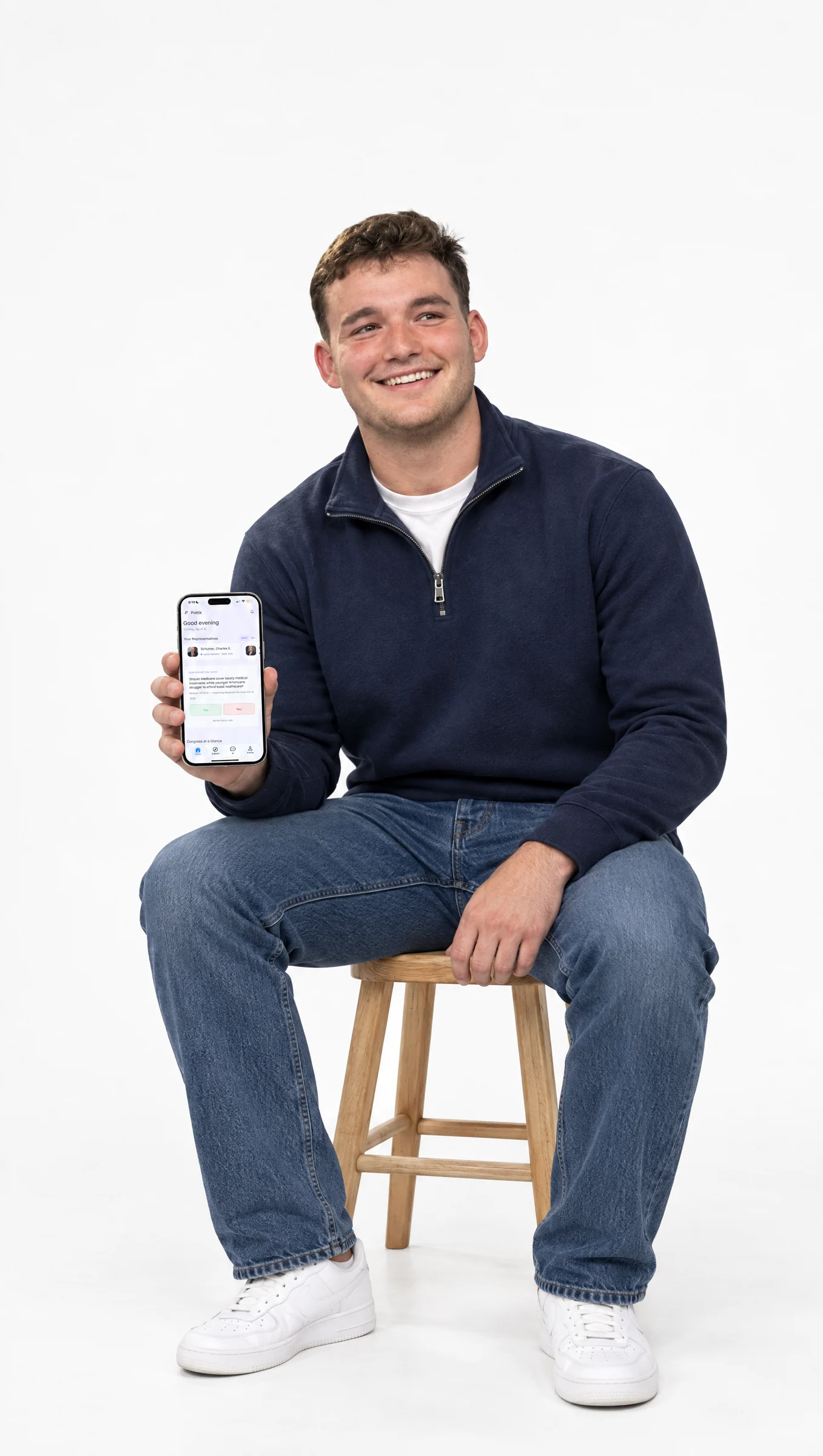
Timelines can be short when the scope is honest. Politik is the example I point to. Three college founders who had never shipped software came to us with the domain knowledge and a distribution plan. We ran a two-week product sprint with them, and the app reached the App Store in under three months. It had 4,000 users on launch day and hit #2 on the App Store within a week.
Red Flags
- A price on the first call. Nobody can price a product they have not scoped. A fast number is a low number that grows.
- They agree with everything. A team that has shipped first versions will tell you which half of your list to cut. If every feature gets a yes, they are selling hours.
- No apps you can install. Figma files, password-protected demos and logos of large companies are not shipped products.
- The code lives with them until the final payment. You should see commits in your own repository every week.
- Their accounts, their framework. An app published under their Apple account or built on their in-house platform is an app you rent.
- The cheapest quote by half. If two companies say $70,000 and one says $30,000, the third has not understood the product or plans to bill the difference later.
- More than 40 percent up front. A deposit is normal. Most of the money should follow milestones you can see.
- They will not name the team. Or the team changes between the proposal and the kickoff.
- Launch is the end of the contract. The first month after launch is when you learn the most and need the builders most. Ask what support looks like and what it costs.
One of these deserves a direct question. Two is a reason to move to the next company on your list.
What a Good First Two Weeks Looks Like
You can tell most of what you need to know about a company in its first ten working days. Good ones are busy in ways you can see.
In the first week you should have a kickoff with the full team, not only the account lead. They ask about your first customer and what that person does today without your product. The feature list gets sorted into what ships in version one and what waits, and you will lose arguments about some of it. By Friday there is a written scope: a list of screens, the user roles, the integrations and what is out.
The second week turns that into things you can look at:
- Designs for the core flow in Figma, on real screen sizes, that you can click through.
- A repository in your GitHub organization with the first commits in it.
- Your Apple Developer and Google Play accounts created in your company's name, with the team invited.
- A short document that names the stack and explains each choice in a sentence.
- A milestone plan with a date for the first build on your phone.
- One channel for questions and a fixed time each week for the demo.
Watch for the opposite pattern. Two weeks of meetings, a long requirements document and nothing to click or clone means the next ten weeks will look the same. It is cheaper to leave in week two than in month three, so write an exit after the scoping phase into the contract.

What You Should Own at Handover
At the end of the project you should be able to fire the company the next morning and keep running. That is the test. Here is what has to be in your hands for it to pass.
- The source code, in your repository, with the full commit history and a README that gets a new developer running in under an hour.
- The store accounts. Apple Developer and Google Play in your company's name, with the signing certificates and keys.
- The cloud accounts. Hosting, database, file storage and the domain, billed to your card, with you as the owner.
- Every third-party account. Stripe, analytics, email, push notifications, any AI provider. You own it and the company was a guest.
- The design files, in your Figma workspace, including the component library.
- Credentials and secrets in a password manager you control, with the company's access removed on the day you choose.
- A written handover. How to deploy, how to roll back, what is known to be broken and what they would build next.
- An IP assignment signed by the company, covering everyone who touched the code, including contractors.
Ask for this list on the first call, before any money moves. A company that plans to hand all of it over will say yes without thinking. One that hesitates has told you how the project ends.
Most of what is in this article can be checked before you sign. Download the apps, call the founders, meet the team, read the contract for who owns what. A company that passes all four is rare enough that price becomes the smaller question.
This is what we do. We build MVPs for founders, from the first scoping call to the App Store, and we have launched fifty products. If you have an idea and want a plan and a number before you commit to anyone, book a free strategy call.