The Short Answer for DC Founders
Hiring app developers in Washington DC means paying more than most of the country and competing with federal contractors who can offer clearance work. The metro had 69,060 software developers at a median of $154,930 in the Bureau of Labor Statistics figures for May 2025, 13.9% above the US median. For a first consumer or B2B app with nobody technical on your side, pick a team that shows you a build every week and puts a fixed number in writing, then hire in DC once the product has users.
If your buyer is a federal agency, the answer changes. You need a cleared contractor with a contract vehicle, and that is a different kind of company from the one this guide is about.
The pay figures, sectors and places to start are also on our Washington DC app development page, each with its source. For interview questions and contract terms that apply in any city, read how to hire an app developer.
What a Developer Costs in DC
These are Bureau of Labor Statistics figures for May 2025, for software developers in the Washington, Arlington and Alexandria metro, as republished by Wagedex.
- Median pay: $154,930 a year, or $74.49 an hour. The US median is $135,980.
- Mean pay: $153,100 a year.
- 10th percentile: $96,450.
- 25th percentile: $123,720.
- 75th percentile: $176,230.
- 90th percentile: $213,660.
The same page ranks the metro 15th of 500 areas. One detail stands out. The mean sits below the median, which is unusual. Pay here is bunched in the middle, with cleared and contract work holding up the floor. You will not find a cheap bottom tier to hire from. The 10th percentile is $96,450.
Those are salaries. Benefits, payroll taxes, a recruiter and equity sit on top, and one developer is still not a designer or a QA lead. Our breakdown of what it costs to hire a mobile app developer covers the rest of the bill.
The clearance premium
A clearance is worth money in this region, and every cleared candidate knows it. The ClearanceJobs compensation report, published March 31, 2026, put average total compensation for cleared professionals at "an all-time high of $126,125". Respondents in the District averaged $136,369, in Virginia $138,748 and in Maryland $139,303. Those holding a lifestyle or full scope polygraph averaged $149,875.
Those are averages across every cleared job, not only software. They still tell you who you are up against. A developer with a TS/SCI and a steady contract has a reason to stay, and your startup equity has to beat a job that cannot be outsourced. Most of the time, it will not. Recruit people without a clearance, or people who are tired of the paperwork.
What agencies in the city report
Clutch's Washington list showed 368 companies when we checked in November 2026, with self-reported hourly bands from "$25 - $49 / hr" at the bottom to "$150 - $199 / hr" at the top. Read the profiles closely. A good share of those firms are set up to win federal work, with past performance on agency contracts rather than apps in the App Store.
Who You Are Bidding Against
In most cities your competition for engineers is other startups and a few big tech offices. In DC it is the federal government and the companies that sell to it. That pull changed in the last two years, and it matters for when you hire.
The federal cuts moved people into the market
Federal employment in the Washington metro fell from "about 375,800 jobs to 312,500", the lowest level in 30 years, and the metro lost "100,500 total jobs from May 2025 to May 2026", per WJLA on July 21, 2026, citing BLS data. Technical.ly reported on January 5, 2026 that tech jobs in the DC region "notably decreased between 2024 and 2025".
For a founder this cuts two ways. More people are looking, including engineers who built internal tools at agencies and contractors whose task orders ended. But most federal software work is backend systems, data pipelines and compliance, not a consumer app with push notifications and an onboarding flow. A strong résumé from a program office does not prove someone can ship to the App Store. Ask for a store link every time.
The private employers
- Policy and civic software. FiscalNote and Morning Consult both have their headquarters in the District. Engineers from either have worked with legislative data, which is messy, updated on its own schedule and full of edge cases.
- Defense tech. HawkEye 360 raised $150 million and Heven AeroTech reported $100 million after moving its headquarters from Miami to Sterling, per Technical.ly on January 20, 2026. These companies hire cleared engineers at defense pay.
- Energy. The same report says X-Energy of Rockville accounted for 26% of the region's annual total, through a $779 million Series C1 and a $700 million Series D. Most of the big DC numbers are Maryland and Virginia companies.
The headline number from that report: DC-area startups raised $5.4 billion in 2025 from 323 deals, about 25% fewer deals than four years earlier. More money in fewer, larger rounds. If you are raising a seed round, that means investors are pickier, and a working app is a stronger argument than a deck.
Four Ways to Get the App Built in DC
Each of the four works for someone. The fields are the same for each, so you can compare them line by line.
1. Hire your own developers
- Good for: a product with users and a roadmap, and a company that wants the knowledge kept inside.
- Watch for: months of recruiting before code. One engineer is one skill. Design, QA and the launch still need an owner.
- In DC: one developer at the median is $154,930 a year, and you are hiring against contractors who can offer clearance work and stable task orders. The federal cuts have put more candidates on the market, but check that they have shipped consumer software.
- Time to a first build: the slowest of the four.
2. A local agency
- Good for: a full team from the first week, and meetings downtown or in Arlington if you want them.
- Watch for: a firm built for federal proposals. Their process is tuned to statements of work, compliance documents and long review cycles, which is right for an agency buyer and slow for a startup.
- In DC: 368 companies on Clutch. Ask how many apps they shipped to the App Store for private clients in the last two years, and install one.
- Time to a first build: a few weeks from first call to kickoff, if they have room.
3. A freelancer
- Good for: one defined piece of work, started this week.
- Watch for: a single person covers a single skill. If a contractor offers them a cleared role, your context leaves with them.
- In DC: many former federal staff and contractors are freelancing between jobs right now. Some are excellent. Treat it as a project with an end date, not a team.
- Time to a first build: the fastest start. Also the option most likely to stall halfway.
4. A product team
- Good for: a first version when nobody on your side writes code. Design, iOS, Android, web and AI come from one team, with a fixed number in writing before you commit.
- Watch for: they are not your staff. After launch you keep them on or you hire. It is not the cheapest line on this list either.
- In DC: this is the option we are. We have no office in DC. Founders there work with us over calls and a demo every week on Eastern time. We do not take federal contract work.
- Time to a first build: a demo every week on TestFlight or a live URL once the design is approved.
The longer argument for each model, with the cases where each one fails, is in in-house vs agency vs freelance.
Where DC Founders Find Help
The support DC offers founders has changed a lot since 2024. Older guides send you to places that have closed.
Station DC
1776, the incubator most guides still mention, "shuttered its last DC location in 2021", per Technical.ly, updated December 6, 2025. Its cofounder Evan Burfield went on to Station DC, a 10,000 square foot hub in the Union Market District run as a nonprofit and opened with Capital Factory, the Austin entrepreneurship firm, as partner. The same article says it is the first location Capital Factory has opened outside Texas and that the DC Council granted $2 million to support it. Station DC now describes itself as "the non-profit for technologists and policymakers advancing American national interest". If you are building defense or govtech, go there.
The DC Venture Capital Program
The District runs its own fund. DMPED describes it as "a new $26 million fund designed to make equity investments in pre-seed, seed, and early-stage tech companies based in Washington, DC", with private investors required to put in at least an equal amount. On December 17, 2025, Technical.ly reported that Hustle Fund and Lytical Ventures were picked as fund managers, with K Street Capital running the program, and that investments go to companies "headquartered in DC proper". An address in Arlington or Bethesda does not count. Decide where you incorporate and lease before you pitch.
Techstars, now for healthcare only
The general Techstars DC accelerator ended with its 2024 cohort, as Technical.ly reported in August 2024. What remains is the Techstars Healthcare Accelerator powered by Permanente Medicine Mid-Atlantic States. Its 2026 class started September 8, with Demo Day on December 9, 2026. If you are in it, plan the build backward from that date. Patient data means HIPAA work before the first feature, and our guide on what a telemedicine app costs covers that bill.
Universities, Halcyon and the October week
Georgetown's Bark Tank awards "up to $100,000 annually to student entrepreneurs", and the 2026 final ran on November 10. Halcyon backs early social ventures in climate, health and equity tech. DC Startup and Tech Week ran October 19 to 23, 2026, at venues across DC and Virginia, and says it brings together "17,000+ founders, investors, builders, and tech leaders". That is the week to meet local engineers in one place. Put the 2027 dates in your calendar now.
DC, Maryland and Virginia Rules That Change the Hire and the Build
We are not lawyers and this is not legal advice. It is the list we would take to one before hiring in the District. Many of your hires and users will live across the river or the Maryland line, so three jurisdictions are in play.
Noncompetes are mostly banned in DC
DC bans most noncompetes, and the exception that matters for hiring is highly compensated employees. "Effective January 1, 2026, the DC noncompete salary threshold is $162,164", per Epstein Becker Green on January 28, 2026. Put that next to the BLS figures. The median DC developer earns $154,930, below the line. The 75th percentile, $176,230, is above it.
So a mid-level developer you hire from a District employer probably did not sign an enforceable noncompete, and you cannot use one on them either. A senior hire might have. Ask, get a copy, and give it to your lawyer before the offer goes out. For your own offers, a strong invention assignment and a confidentiality agreement do most of the work at seed stage.
Pay ranges go in every posting
Since June 30, 2024, the DC Wage Transparency Omnibus Amendment Act "applies to any employer with at least one employee in the District", per Littler's January 2024 summary. Employers "must disclose the minimum and maximum projected salary or hourly pay" in listings, have to tell applicants about healthcare benefits "before the first interview", and cannot screen applicants on wage history.
Illinois starts its version of this rule at 15 employees. DC has no headcount floor. Your first developer posting needs a range. The upside is the same as anywhere with this rule: twenty current postings give you the market for free.

Maryland's privacy law reaches small apps
DC has no comprehensive consumer privacy law of its own, but your users in the suburbs bring theirs. The Maryland Attorney General says the Maryland Online Data Privacy Act went into effect on October 1, 2025, and covers businesses handling the data of "at least 35,000 Marylanders". It also says "a controller cannot sell sensitive data", and sensitive data includes precise geolocation, biometric data and a child's data. A regional app with a location feature can cross 35,000 Maryland users faster than you would think.
Virginia's Consumer Data Protection Act sets the bar higher, at "personal data of at least 100,000 consumers" in a calendar year, per the Virginia Code, section 59.1-576. Build consent, deletion and data export in from the start. Retrofitting them after launch costs more than doing it once.
What to Check Before You Sign
Run these on an employee, a freelancer, an agency and on us.
- A store link. An app you can install today. Federal portfolios often cannot be shown, so ask for private work you can use for ten minutes.
- What they signed before. A noncompete, a nonsolicit, an invention assignment. Check their pay against the $162,164 DC threshold, and note that Virginia and Maryland have their own rules.
- Who writes the code, by name. Meet the engineers before the contract. A K Street address tells you where the sales team sits.
- Who owns the code and the accounts. The repository lives in your GitHub organization. The Apple and Google developer accounts are in your company's name.
- A posting with a range. If you are hiring, your listing follows the DC pay rule from the first role.
- A privacy plan. Where user data is stored, how consent is captured, and what happens when a Maryland user asks for deletion.
- A fixed number in writing. Scope, price, date, and a written process for changes.
- A build every week. TestFlight or a live URL, on your phone.
The longer version of the agency checks, with how to read a proposal, is in how to vet a software development agency.
When an Agency or Product Team Is the Wrong Call
We build apps for a living, so read this with that in mind. Some DC founders should not hire a team like ours.
- Your customer is a federal agency. You need a cleared team, a contract vehicle and past performance on government work. We do not take federal contract work. A local federal contractor is the right call.
- The product touches classified systems or needs a FedRAMP authorization on day one. That is a compliance program with an app attached. Hire the people who have done it.
- You can pay at the 75th percentile, $176,230, and plan to ship every week for years. Hire a strong senior engineer, give them equity, and build the team around them.
- You need someone in your office every day. We are not in DC. If sitting next to the person writing code matters most to you, hire locally.
- The work is one integration or one bug. That is a freelancer's job.
The opposite case is the one we fit. You know the product and the buyer, the buyer is a person or a private company, nobody on your side writes mobile code, and you need design, a backend and an app on one schedule with the cost known up front.
How DC Founders Work With Us
Founders in DC work with us over calls and a demo every week, on Eastern time.
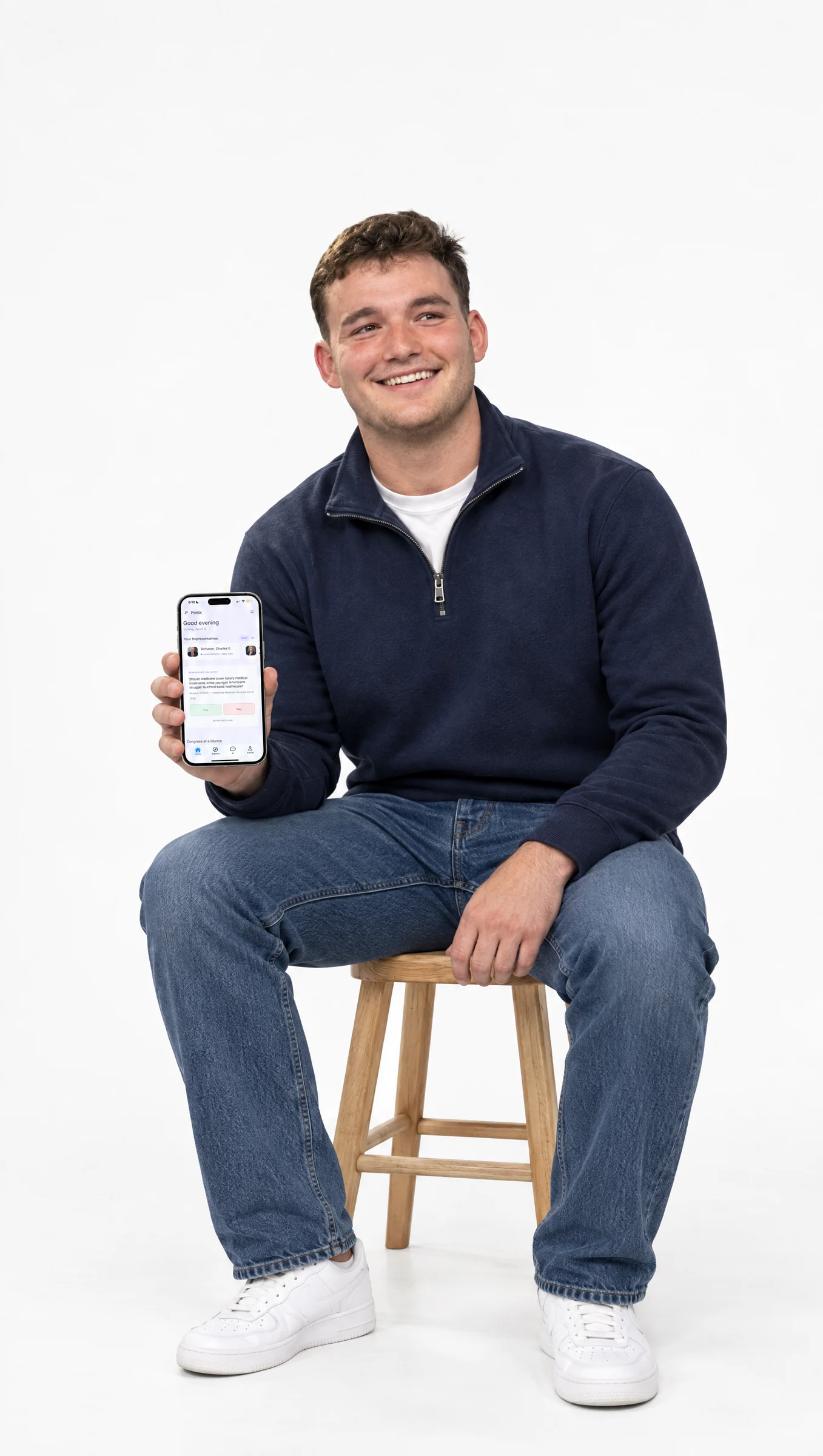
We have shipped a product built on the data this city produces. Politik's three founders were international relations majors fresh off a summer on Capitol Hill, and they had never shipped software. Politik resolves any zip code to its district, senators and House member using Congress.gov, the Google Civic Information API and OpenStates. A scheduled ingestion pipeline pulls Congress.gov, campaign finance and state data into one feed, and its AI explains any bill or vote in plain English from that data. It shipped to the App Store in under three months as a React Native app with a Node.js backend, had 4,000 users on launch day and hit #2 on the App Store within a week. The Politik case study has the screens.
The week runs the same way for every founder:
- A thirty minute scoping call. You leave with a plan and a number.
- Design. Every screen approved in Figma before a line of code.
- Build. A new build each week on TestFlight or a live URL.
- Launch. The App Store, the web and the first month after.
We design and build iOS, Android, web and AI products with Washington DC founders, about eight weeks to the App Store. The local pay figures, sectors and places to start are on our app development page for Washington DC. If you have a product in mind and want a plan and a number, Book a free strategy call.