
Why Two Weeks Is the Right Window for MVP Scoping
Most founders spend too long scoping their MVP or not long enough. Three months of planning leads to a bloated feature list that no development team can ship in a reasonable timeline. Two days of brainstorming leads to a feature set full of assumptions that crumble the moment code hits production. Two weeks sits in the sweet spot: long enough to do real research, short enough to maintain urgency and prevent scope from expanding unchecked.
The goal of scoping is not to plan your entire product. It is to answer one question with confidence: what is the smallest thing we can build that proves or disproves our core hypothesis? Every feature in your MVP should connect directly to that answer. If a feature does not help you learn whether your product solves a real problem for real people, it does not belong in the first release.

We have run this process with over sixty founders at Kanopy, and the pattern is consistent. Week one is about understanding: who your users are, what they actually need, and where existing solutions fall short. Week two is about deciding: which features make the cut, what the product looks like, and how it gets built. By the end of day ten, you walk away with a locked scope document that a development team can estimate, plan, and start building from immediately.
This is not a theoretical framework. It is the exact process we use before every MVP development engagement. The two weeks of scoping save months of rework downstream because the team builds the right thing from day one instead of discovering misalignment in week six of development.
Week 1: Research, Analysis, and Core Value Proposition
Week one is about inputs. You are collecting evidence, not making decisions yet. The temptation is to jump straight to listing features because it feels productive. Resist it. Features without research behind them are just guesses dressed up as plans.
Days 1 and 2: User Research
Start with your target users, not your product idea. Schedule six to ten interviews with people who match your target persona. These should be 30-minute conversations, not product demos. You are not pitching. You are listening. The interview script should focus on three areas: how they currently solve the problem you are targeting, what frustrates them about their current approach, and what "solved" would look like for them in concrete terms.
Do not ask leading questions like "Would you use an app that does X?" People say yes to hypothetical products. Instead, ask behavioral questions: "Walk me through the last time you dealt with this problem. What did you do? What tools did you use? Where did you get stuck?" The answers reveal what matters, not what sounds appealing in a survey.
Synthesize the interviews into a one-page document: top three validated pain points, direct user quotes supporting each, and the primary persona you are building for. This document becomes the filter for every feature decision in week two.
Days 3 and 4: Competitor Analysis
Competitor analysis is not about copying features. It is about understanding the landscape so you can position your product intentionally. Sign up for the three to five closest competitors. Use each one to complete the core task your product will address. Take screenshots, note friction points, and document where each competitor excels and where they fail.
Build a simple comparison matrix in Notion or a spreadsheet. Rows are competitors, columns are capabilities. The point is to identify the gap your product fills. If every competitor already does what you are planning to build, and does it well, your feature set needs to differentiate or you are entering a crowded market without a wedge.
Pay special attention to pricing pages and onboarding flows. Pricing tells you how competitors monetize and which user segment they prioritize. Onboarding reveals what they consider their core value proposition, because that is what they show new users first.
Day 5: Core Value Proposition
By Friday of week one, you should be able to complete this sentence: "We help [specific persona] do [specific task] better than [current alternative] by [specific differentiator]." If you cannot fill in every blank with a concrete answer backed by your research, you need another round of interviews or a sharper competitor analysis.
This value proposition is not marketing copy. It is an internal alignment tool. When someone on the team suggests a feature in week two, you hold it against this statement. Does it directly support the core value proposition? If not, it goes on the "post-launch" list. Every MVP that ships on time has a post-launch list that is longer than the feature list. That is how it should be.
Week 2: Feature Prioritization, Wireframes, and Technical Decisions
Week two is about outputs. You take everything learned in week one and convert it into a buildable plan. The key discipline here is making decisions and locking them. Week two is not a brainstorming session. It is a series of deliberate choices about what gets built, what gets deferred, and how the pieces fit together.
Days 6 and 7: Feature Brainstorm and Prioritization
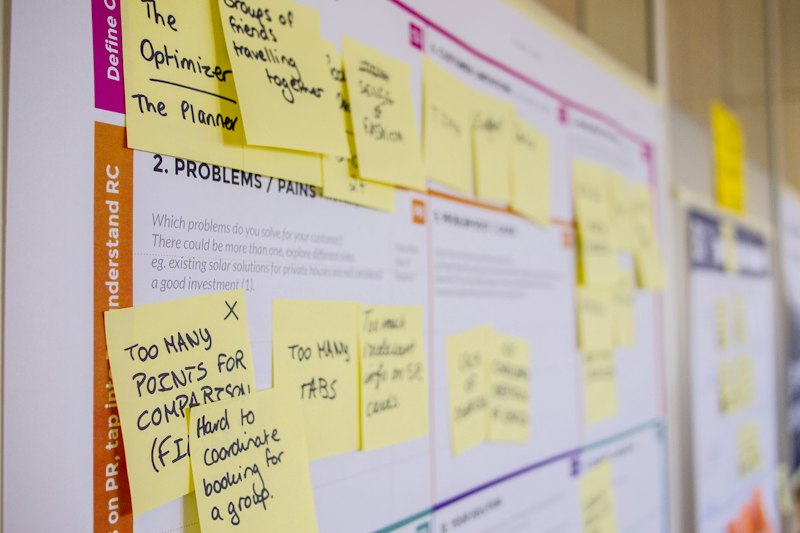
Start with a wide-open brainstorm. Write down every feature anyone on the team can think of. Do not filter during this step. Get it all on the board: the obvious features, the ambitious ones, the nice-to-haves, the "we will definitely need this someday" ideas. Use Notion, Linear, or even sticky notes on a wall. The medium does not matter. Completeness does.
Now apply a prioritization framework. We use a modified RICE scoring model (Reach, Impact, Confidence, Effort) for most MVP scoping projects. Each feature gets scored on a scale of one to five for each dimension. Reach measures how many of your target users will interact with this feature. Impact measures how directly it supports your core value proposition. Confidence reflects how certain you are about reach and impact based on your research. Effort is the estimated development complexity.
The formula is simple: (Reach x Impact x Confidence) / Effort. Sort your features by score. The top of the list is your MVP. The bottom is your post-launch roadmap. There will be edge cases and judgment calls. Some high-scoring features depend on lower-scoring infrastructure that needs to come first. But the ranking gives you an evidence-based starting point instead of a gut-feeling feature list.
Day 8: Wireframes and User Flows
With the feature list locked, sketch the core user flow in Figma or on paper. The wireframe covers every screen the user touches from signup to completing the primary action your product enables. This is not about visual design. It is about information architecture: what goes on each screen, how screens connect, and where the user makes decisions.
Keep wireframes low fidelity. Gray boxes, placeholder text, simple layout. The point is to validate flow logic, not to choose fonts. Show the wireframes to two or three people from your interview pool and watch them walk through the flow. Where do they hesitate? Where do they expect something that is not there? These observations refine the feature set further before any code gets written.
Days 9 and 10: Technical Decisions and Scope Lock
The final two days cover the technical choices that shape development. Your engineering lead or technical advisor makes calls on the stack: framework, database, hosting, authentication provider, and any third-party services the product requires. These decisions should be driven by the product requirements defined earlier in the week, not by personal preference or trend-chasing.
If you are validating a SaaS idea, speed matters more than scalability. Choose boring technology that your development team knows well. A well-executed Rails app or Next.js project will outperform a cutting-edge architecture that takes twice as long to build. Save the Kubernetes cluster for the day you have a scaling problem worth solving.
Day ten ends with a scope lock meeting. Every stakeholder reviews the final feature list, wireframes, and technical plan. Everyone signs off. From this point forward, the scope does not change until after launch. New ideas go on the post-launch list. This is not inflexibility. It is the only reliable way to ship on time.
The Art of Cutting Features (Without Cutting Value)
Feature cutting is the hardest part of MVP scoping, and it is the skill that separates founders who ship from founders who are still planning six months later. Every feature you add to the MVP increases development time, introduces potential bugs, and dilutes your team's focus. The math is brutal: a ten-feature MVP takes roughly three times longer to build than a five-feature MVP, because of the interaction effects between features, not just the features themselves.
Use the MoSCoW framework as your cutting tool. Every feature on your list gets classified into one of four categories: Must Have, Should Have, Could Have, or Won't Have (this release). Must Haves are features without which the product literally cannot deliver its core value proposition. If you are building a scheduling tool, calendar integration is a Must Have. Dark mode is a Won't Have.
The most common mistake founders make is confusing "I want this" with "users need this." Your research from week one is the antidote. If a feature did not come up in user interviews, if no competitor offers it as a primary value driver, and if removing it does not break the core user flow, it is not a Must Have. Move it to Should Have or Could Have and revisit it after launch when you have real usage data.
Here is a practical test: for each feature, ask "Can a user complete the primary task without this?" If the answer is yes, the feature is not essential for the MVP. Authentication is essential. A password reset flow is essential. A social login option with four OAuth providers is not. Email notifications when something important happens are essential. Granular notification preferences with per-channel controls are not.
Another powerful question: "What is the manual workaround?" If you can handle the first fifty users with a manual process instead of building automation, defer the automation. Early-stage products benefit from manual touchpoints because they create learning opportunities. You discover what users actually need by doing the work yourself before codifying it into software.
Cut ruthlessly and document why. Keep a "Cut Features" section in your scope document with a one-sentence explanation for each deferred feature. This prevents relitigating the same decisions during development and gives you a ready-made roadmap for version two.
Common Scoping Mistakes That Derail MVPs
After working with dozens of early-stage founders, we see the same scoping mistakes repeat. Knowing them in advance does not make you immune, but it makes you faster at recognizing when you are drifting.
Mistake 1: Building for everyone instead of someone. Your MVP should serve one persona with one core problem. When founders try to address multiple user types or solve adjacent problems simultaneously, the product becomes mediocre at everything instead of excellent at one thing. Pick your beachhead user and build exclusively for them. Other personas come in version two, after you have proven the core works.
Mistake 2: Treating the MVP like a scaled product. Your MVP does not need role-based access control, audit logging, GDPR compliance tools, or a public API. It needs to solve one problem well enough that users come back. Infrastructure features belong in the roadmap, not the first release. The exception is security: authentication, authorization for core data, and encryption in transit are non-negotiable from day one.
Mistake 3: Designing features by committee. When five stakeholders each add their "one more thing," you end up with a feature list that serves no one coherently. Scoping needs a single decision-maker. That person listens to all input, weighs it against research, and makes the call. Democratic feature selection produces political products, not useful ones.

Mistake 4: Skipping user research because "we know the market." Even domain experts get surprised by user interviews. You may know the industry, but you do not know which specific problem your target users will pay to solve until you ask them. Two days of interviews will either confirm your assumptions (giving you confidence to build) or redirect them (saving you months of building the wrong thing). Either outcome is valuable.
Mistake 5: Confusing a feature list with a scope document. A feature list says what you will build. A scope document says what you will build, how the features connect, what the user flow looks like, which technical choices support the product, and what is explicitly out of scope. Without the full context, developers fill gaps with their own assumptions, and those assumptions rarely match yours.
Mistake 6: Not defining "done." Every feature needs acceptance criteria before development begins. "User profile" is not a feature definition. "User can upload a profile photo, edit their display name and bio, and view their account creation date" is a feature definition. If you cannot describe what "done" looks like, the feature is not scoped. It is a wish.
Your Scoping Deliverables Checklist
By the end of two weeks, you should have a complete set of deliverables that any competent development team can pick up and start building from. If you are missing any of these documents, your scoping is not finished.
- User Research Synthesis: One-page summary of validated pain points, target persona definition, and direct quotes from interviews. This document is the "why" behind every feature in your MVP.
- Competitor Analysis Matrix: A comparison of three to five competitors across key capabilities, with notes on pricing models, onboarding approaches, and the specific gap your product targets.
- Core Value Proposition Statement: A single sentence that defines who you serve, what you help them do, and how you differ from existing options. Every team member should be able to recite this from memory.
- Prioritized Feature List: Every feature scored using RICE or a similar framework, categorized using MoSCoW, with a clear line drawn between "in the MVP" and "after launch." Each feature includes a one-paragraph description and acceptance criteria.
- User Flow Wireframes: Low-fidelity screens covering the complete core user journey. Every screen connected, every interaction annotated, every edge case noted. Built in Figma or a similar tool that the design team can iterate on.
- Technical Architecture Brief: The stack decision, database choice, hosting plan, authentication provider, third-party integrations, and any technical constraints or dependencies. This is not a full technical spec. It is enough for a development team to validate the approach and provide an accurate estimate.
- Cut Features Log: A documented list of every feature that was considered and deferred, with a one-sentence rationale for each. This prevents scope creep during development and seeds your post-launch roadmap.
- Scope Lock Agreement: A signed-off document confirming that all stakeholders agree on the feature set, timeline expectations, and the process for handling change requests during development.
These eight deliverables are the output of two focused weeks. They transform a product idea from something you talk about into something you can build. If you have followed the idea to launch process before, you know that scoping quality directly predicts development speed. Teams that start with clear scope documents build faster, encounter fewer surprises, and ship closer to their original timeline.
Working With a Development Team After Scoping
Good scoping makes the handoff to development dramatically smoother. Instead of a kickoff meeting where the dev team asks a hundred clarifying questions, you walk in with answers already documented. The first development sprint starts with real work, not two weeks of requirements gathering that should have happened during scoping.
When evaluating a development partner, pay attention to how they react to your scope documents. A strong team will read them closely, push back on specific features with technical reasoning, and suggest simplifications you had not considered. A weak team will accept everything without questions. No scope document is perfect, and a development team that does not challenge it is either not reading it or not experienced enough to spot the gaps.
Share the research synthesis alongside the feature list. Developers who understand the user context make better implementation decisions. When an engineer knows why a feature exists, they can make smart tradeoffs during implementation without escalating every minor decision. "The user needs to find available time slots quickly" leads to a different database query strategy than "show a list of time slots." Context produces better code.
Establish a change request process before development begins. Changes will come up. Market conditions shift, user feedback arrives, technical constraints surface. The process should be simple: document the proposed change, assess its impact on timeline and scope, and get sign-off from the decision-maker before any code changes. Without this process, scope creep enters through the back door as "small adjustments" that compound into weeks of additional work.
Finally, plan for the transition from MVP to version two before development starts. The post-launch list you created during scoping is not a backlog. It is a set of hypotheses about what users will need next. After launch, you validate those hypotheses with real usage data, user feedback, and metrics. Some features you deferred will turn out to be critical. Others will turn out to be irrelevant. The data tells you which is which, and that is far more reliable than the opinions you had during scoping.
If you are ready to scope your MVP with a team that has done this dozens of times, Book a free strategy call and we will walk through your product idea, target market, and the fastest path to a locked scope document you can build from.